
Buying a house is the biggest purchase most Texas families ever make. Protecting it shouldn’t be the part you don’t understand.
Key Takeaways
- Homeowners insurance protects the house, your belongings inside it, and you if someone gets hurt on your property.
- Six coverages sit inside a standard policy. Most people never look at more than two of them.
- Flood isn’t covered. Not by any standard policy. Something a lot of Texans learn the hard way.
- Texas premiums run higher than most states. Around $3,970 a year on average (LendingTree 2026), though your number can look very different.
- Your lender will make you carry a policy. Even without a lender, going without one is a bet most families shouldn’t make.
- An independent agent pulls quotes from multiple carriers in one sitting. You get to see the real picture instead of one company’s version of it.
Most folks buy their first homeowners insurance policy at closing. Sign the papers. Move on. Never open the document again until something breaks or burns.
That’s not the time to figure out what’s in there.
We’ve been doing this in Texas since 2015, and the pattern doesn’t change much. Family calls after a hail storm. Or a kitchen fire. Or a slip-and-fall on the porch. And that’s when they find out what their policy actually says.
So let’s fix that now, before anything goes wrong.
What Homeowners Insurance Actually Is
It’s a contract. You pay a premium. The insurance company agrees to cover certain kinds of damage or loss to your home, your things, and your finances.
Think of it as a safety net stitched from several smaller nets. One catches damage to the house. Another catches your furniture, your electronics, everything you’d pack if you moved. A third catches you if a guest slips and needs a hospital visit. Together, they keep one bad afternoon from wiping out years of savings.
The technical name for the most common form is an HO-3. Open-perils on the structure, which sounds like jargon but matters. Open-perils means everything’s covered except what the policy specifically excludes. That exclusion list is short. Named-perils policies work the opposite way, and the list of what they cover is a lot shorter than most people expect.
You want open-perils on the house. Almost always.
parts of insurance
The Six Parts Nobody Explains
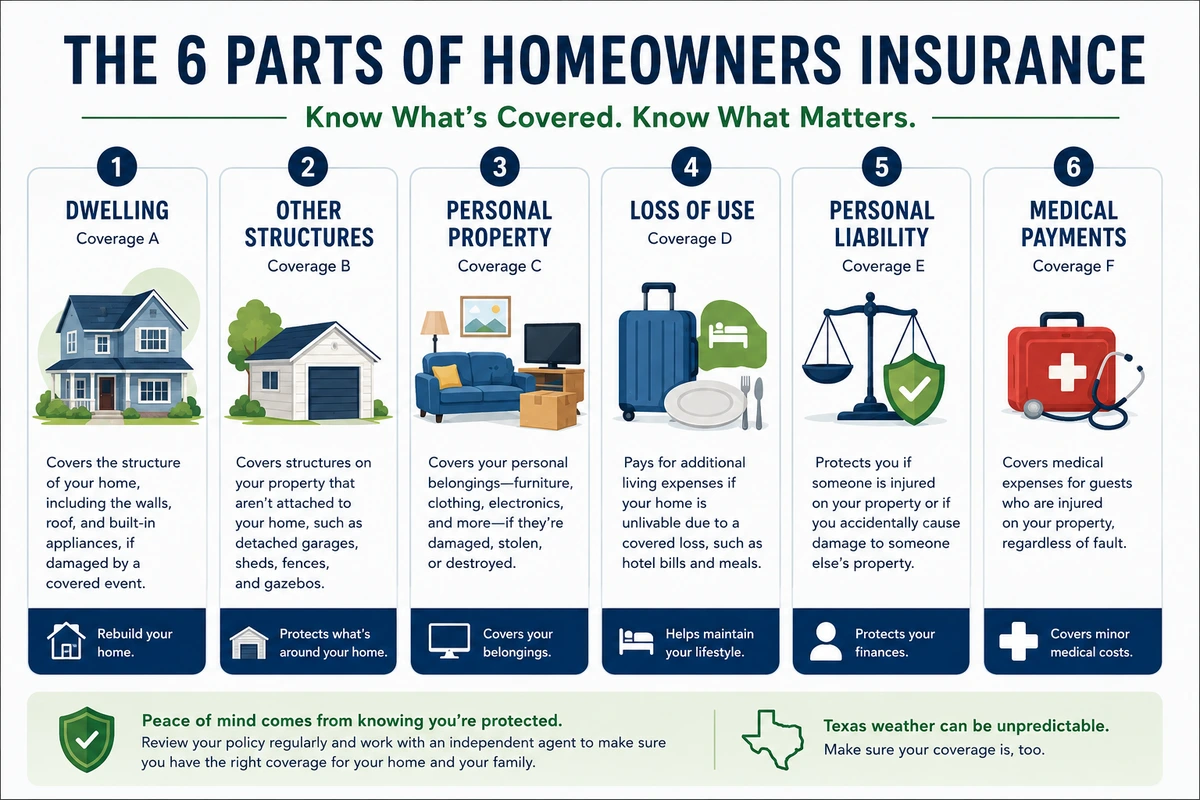
Every standard policy runs on the same six coverages. Insurers label them Coverage A through F. Quick tour.
Coverage A: Dwelling. The house itself. Tree comes through the roof at 2 a.m., or a grease fire jumps the stovetop, or last April’s hail chews up your shingles — Coverage A is what rebuilds it. The number on your policy needs to match what it’d cost to rebuild your house today. Not market value. Not what you paid back when. Rebuild cost. Big difference, and most families never get it re-checked.
Coverage B: Other Structures. The stuff on your lot that isn’t attached. Detached garage. Backyard shed. That gazebo the previous owner left you. Default runs about 10% of Coverage A. You can raise it if the structures on your property are worth more than that.
Coverage C: Personal Property. Your things. The couch. Kids’ clothes. Kitchen gear you’ve bought over ten years and never replaced. Every laptop, every TV, every console. Default sits somewhere between 50% and 70% of dwelling coverage. Own something high-value? Jewelry, firearms, art — those items usually need to be scheduled on your personal insurance policy separately. Otherwise the internal cap kicks in and you find out at claim time that the ring you thought was covered for its full value is really only covered for about $1,500.
Coverage D: Loss of Use. This is the coverage nobody asks about until they need it. Home becomes unlivable after a covered loss? Coverage D pays the hotel bill. And meals above what you’d normally spend at home. And the laundromat while you wait. A house fire can put a family in a rental for six months. That whole displacement gets funded by this line item.
Coverage E: Personal Liability. The one that protects your bank account when something goes sideways on your property. A guest slips coming up the front steps and sues. Maybe the dog nips somebody. Or, honestly, the more common one — a kid does something on your property that ends with a damage claim. Coverage E handles the legal defense and the payout up to your limit. Baseline usually starts at $100,000, but for most Texas families that’s not where it should sit.
Coverage F: Medical Payments. A smaller, no-fault benefit. Guest gets hurt at your place, this covers their minor medical bills whether anyone was at fault or not. Limits typically run $1,000 to $5,000. Not a big number, but it can keep a small incident from turning into something bigger.
Six pieces. That’s what you’re buying.
For the past eleven years, I’ve had the privilege of handling my mother-in-law’s insurance including the day we first put her policy in place. Back then, she pushed back on the premium (fair, when you’re on a fixed income), so we worked together to find a policy that fit her budget. One of the adjustments we made was to her contents coverage, the protection for everything inside her home, from furniture to appliances to the clothes in her closet. It felt like the right call at the time.
Then came the 2024 hurricane season – Beryl, and her home took a real hit. She had coverage, but not enough, and when it came time to replace what she’d lost, the gap in her contents coverage meant she had to pay some of it out of pocket. We got her back on her feet, and thankfully she never once blamed me for it (she still loves her son-in-law). But that experience taught both of us something every homeowner needs to hear: don’t skimp on your coverage limits, especially contents. You never know when a storm — literal or otherwise — will test just how prepared you really are.
What It Doesn’t Cover
This is where families get surprised, and we’d rather you find out now.
Flood damage. Water rising from outside — a river, storm surge, rain running off the ground into your house — is excluded from every standard policy. Every one. If you’re in Texas, and especially anywhere near the Gulf, that matters more than almost any other exclusion. Flood insurance comes from a separate policy, either through the National Flood Insurance Program or a private carrier.
Earthquake. Rare in Texas. Still excluded.
Wear and tear. Your roof finally giving up after 25 years isn’t a claim. That’s maintenance. Same with old plumbing, old HVAC, old anything.
Termites, mold, pest damage. Considered preventable. Insurance won’t cover what you were supposed to catch.
Business activity out of your home. Running a business out of the house? That needs its own coverage or an endorsement. Not automatic.
High-value items above the sub-limits. Jewelry, cash, firearms, collectibles. Most policies cap these at a few thousand dollars unless you schedule them. If you’ve got a $15,000 engagement ring and don’t schedule it, you’re not covered for $15,000. You’re covered for whatever the sub-limit is. Usually $1,500 or so.
Any of those gaps sound like a problem for your family? We can help you close them.
What Does It Cost?
The honest answer: depends.
Two houses on the same block can pay very different premiums. Age of the home, condition of the roof, credit-based insurance score, claims history, distance to the nearest fire hydrant — all of it moves the number.
That said, ballparks help. LendingTree’s 2026 study puts the average Texas premium around $3,970 a year. Some other studies run higher — Insurance.com landed at $4,085, U.S. News at $4,510. Pick your number. Point is, Texans pay well above the national average of about $2,395. Rates rose more than 54% between 2019 and 2024 alone. Blame Gulf Coast weather, North Texas hail, and the sheer size of the state. The Texas Department of Insurance tracks statewide filings if you want to dig deeper.
What actually moves your price:
- Where the house is. ZIP code. Distance to coast. Wildfire risk. Crime stats.
- What the house is. Age. Square footage. Construction type. Roof age is a big one.
- How much you carry. Higher coverage, higher premium. Higher deductible, lower premium.
- Your history. Recent claims almost always raise the rate.
- Your credit. In Texas, insurers can use a credit-based insurance score. Better score, lower premium. It’s the reality.
Rate climbed recently for no clear reason? That’s worth a second look. Working with an independent insurance agent means we can pull quotes from multiple carriers instead of taking one company’s word for what you should pay.
Is It Required?
Legally? No. Texas doesn’t require homeowners insurance the way it requires auto liability.
Practically? If you have a mortgage, your lender will require it. They’ve got skin in the game and they want protection until you own the house free and clear.
And even if the mortgage is gone and the deed is yours? Going without coverage is a bet against your own future. One fire, one hail storm that totals the roof, one lawsuit from a slip-and-fall — any of those can wipe out years of savings in a single afternoon. For most families, the annual premium is small money against what a policy actually protects.
How Much Do You Need?
Enough to rebuild. Enough to replace what’s inside. And enough liability that a bad afternoon doesn’t come after everything else you’ve worked for.
Start with the dwelling. You want a real replacement cost figure — not market value, not what you paid back in whatever year you closed. What would it actually cost, at today’s material and labor prices, to rebuild your house from a bare lot? That’s the number. And it’s moved a lot since 2020. Lumber, roofing, labor — all up. A dwelling limit that was accurate five years ago is probably short today. We recheck this on every policy review.
Personal property? Walk the house. Every room. Try to picture rebuying what’s in it. Most folks guess low, and by a lot.
Liability’s the one worth thinking about hardest. Look at your total net worth. Savings, home equity, retirement, all of it added up. If that number’s meaningfully bigger than your liability limit, you’ve got exposure you didn’t sign up for. Bumping the limit is cheap. And if you want to go further, an umbrella policy layers another $1 million or more of liability on top for a few hundred dollars a year. That’s the one we recommend most and see the fewest people carrying.
Picking the Right Policy
Price matters. But it’s not the only thing.
Replacement cost vs. actual cash value. Actual cash value pays what your stuff is worth today, minus depreciation. Replacement cost pays what it costs to buy new. Big difference at claim time. Go with replacement cost when you can.
Ordinance or law coverage. Older home? Building codes change. Rebuilding to current code can cost more than the base repair. Ordinance or law coverage bridges that gap. Small line item. Saves headaches later.
Water backup coverage. Sewer or drain backup damage is excluded from standard policies. There’s an endorsement that fixes it. It’s cheap. Get it.
Roof settlement type. Some carriers now pay actual cash value on roofs above a certain age even when the rest of the policy is replacement cost. Read the fine print. Ask.
The carrier itself. A cheap policy from a company that can’t pay claims is worthless. Look for A-rated carriers or better. Every carrier we work with at Actsphere clears that bar. Not most of them. All of them.
Frequently Asked Questions
What’s the difference between homeowners insurance and a home warranty?
Totally different products. Homeowners covers sudden accidental damage — fire, hail, theft, that kind of thing. A home warranty is a service contract for appliances and systems that break down from normal use. Your dishwasher dies. Your HVAC compressor gives out. That’s warranty territory. Most families need both. They don’t overlap the way people assume.
Does homeowners insurance cover flooding in Texas?
No. And this is the exclusion that catches the most people off guard. Rising water, storm surge, rain running off the ground — none of it. You need a separate flood policy. Given how much of Texas sits in a flood zone or near one, this is probably the single most important gap most families have.
How much do I need on my house?
Enough to rebuild it at today’s construction costs. That’s your replacement cost. Different from market value. Different from what you paid. Your agent can run the numbers. Update every few years because construction prices don’t sit still.
Will filing a claim raise my rates?
It can. Especially two or more claims in a short window. Which is why small claims close to your deductible often aren’t worth filing. Big claims usually are. Talk to us before you file. That call is free and we’ve talked plenty of families out of claims that would’ve cost them more in premium hikes than the payout was worth.
Am I covered when I’m traveling?
Yes, mostly. Coverage C follows you and your family. Laptop stolen from a hotel? Suitcase rifled at the airport? The policy generally responds. Sub-limits still apply though, and expensive stuff may need to be scheduled.
What if I have to move out during repairs?
That’s Coverage D — loss of use. Pays for a hotel or short-term rental, meals above what you’d normally spend, laundry, the small extra costs of being displaced. Keep every receipt. The insurer will want documentation.
Can I get coverage if I’ve had claims in the past?
Usually yes. Some carriers weigh claims history heavy, some don’t. Another reason to work with an independent agent. If one company turns you down, another one might not blink. We see it all the time.
Bottom Line
Homeowners insurance is one of the most important protections your family will ever buy. And one of the most misunderstood.
The right policy isn’t the cheapest one. It’s the one that pays what it needs to pay, when it needs to pay it, from a carrier that’ll actually be there when the claim hits.
At Actsphere, we work with more than 25 A-rated carriers. And we treat every policyholder like family. That’s not a slogan. That’s how we were built.
If you’re not sure your current policy is doing its job — or if you’re buying your first house and want somebody to walk you through it — we’re here. Contact our team. Call. Text. Stop in. Whatever works.
Next Steps
Want a second set of eyes on your current homeowners policy? Our homeowners insurance team can review what you’ve got, spot the gaps, and pull comparable quotes from multiple A-rated carriers so you can see options side by side. Call us at (832) 956-1033 or contact us to get started.
